It has an elongated body, narrow and distinct caudal peduncle, small eyes covered by the skin, naked head, its skin thick and well supplied with mucus glands; small cycloid scales; and muscles of the caudal peduncle modified to form an electric organ, and the elephant-like snout. Dorsal head profile straight or somewhat curved, sloping steeply.
Widespread, all major lakes and rivers, Victoria and Murchison Nile. Demersal, inhabiting waters just above the bottom; widespread in both coastal and offshore waters and papyrus fringes.
Primarily insectivore, feeding on insect larvae particularly larval lake-flies (Chironomidae), with most feeding activity occurring at night. The largest specimen recorded was 100 cm long, but the size range of adult fish is usually between 40-60 cm. The adult of this species can give a strong electric shock.

Oreochromis niloticus also called Nile Tilapia in English and locally known as "Ngege". Has a single nostril on each side of the head; dorsal fin with continuous spinous and soft-rayed parts; lateral line interrupted. Cycloid scales. At breeding time; males have distinctive and conspicuous breeding colors and are often bigger than females. Caudal fin with numerous wavy vertical bars. Color is variable depending on habitat: Typically, greyish ground-color, darker above; faint traces of 6 or seven dark vertical bars on the flanks and caudal peduncle.
The most widely distributed species in Uganda; Occurs naturally in Lakes Edward, George and Albert, and in many crater lakes in western Uganda. However, the species has been widely introduced in many other systems, notably Lakes Victoria and Kyoga basins Benthopelagic; common in waters less than 20 m deep in sheltered gulfs and bays with soft muddy bottom.Omnivorous, feeding on phytoplankton (both in suspension or bottom deposits), insects, crustaceans. The species can grow to different sizes reaching between 60 and 70 cm in big lakes.
The species is most preferred among the commercially important species for consumption by the lakeside communities and also the most important in regard to aquaculture.
The most economically important small pelagic fish in Uganda. Present in both inshore and offshore waters as well fast-flowing waters of rivers. Primarily zooplanktivore, but can also feed on surface insects. Mukene rarely exceeds 8 cm, spawns in the lake and produces floating eggs. This is not common with freshwater fishes whose eggs are normally heavier than water.
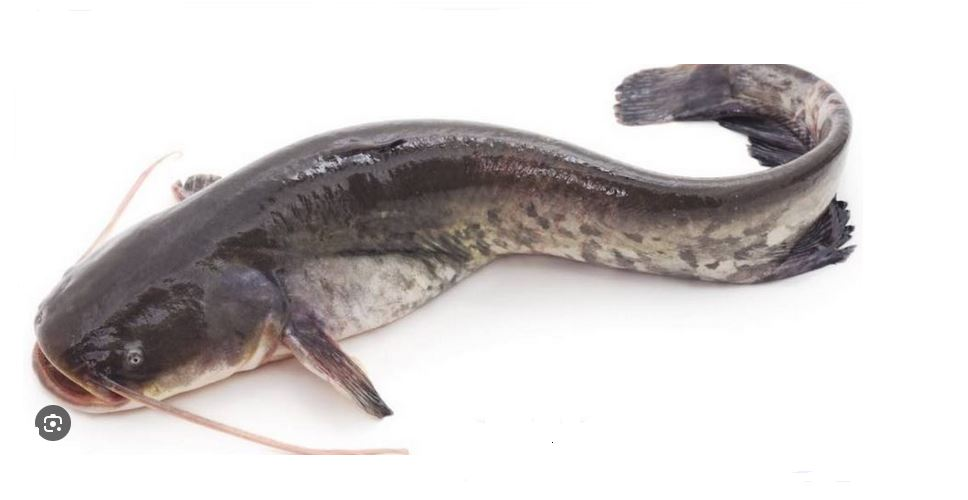
They are extremely hardy fish and have the ability to live for a long time out of water (and, in some cases, actually move across land). The species has an accessory breathing organ that enables it to breath air when very active or under very dry conditions. It can grow up to 120 cm total length.
Widely distributed across the country's water bodies. Known in all major lakes, rivers, minor lakes, small streams and swamps associated with major rivers and lakes. Omnivorous, but predominantly a predator on small fishes (particularly haplochromines) and largely feeds at night.
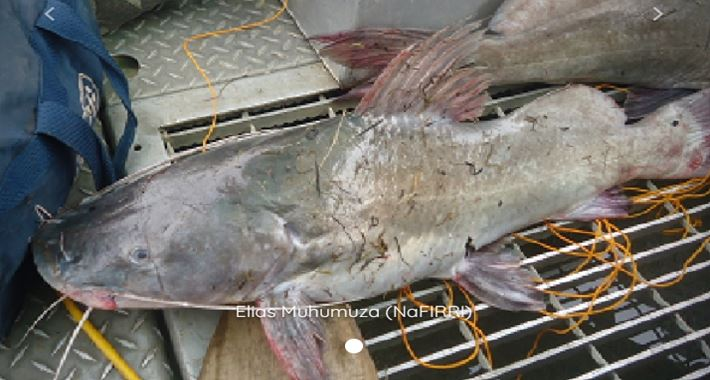
Moderately elongate, slightly compressed, body. Short dorsal and anal fins, the former comprising a spine and 8-11 branched rays. A long adipose fin. Four pairs of circum-oral barbels and has a broad head. Males can easily be recognized by the presence of an elongate genital papilla in front of the anal fin. Wide spread in major lakes rivers, the Victoria Nile, the Semliki river, Murchison and Albert Niles and many minor lakes, and swamps.
The species attains a large size, specimens measuring over 100 cm total length have been recorded from Lakes Victoria and Edward.
It is benthopelagic, living and feeding in waters just above the bottom as well as mid waters; widespread in both deep and shallow waters. Primarily piscivorus, feeding on small fishes (particularly haplochromines and Silver cyprinid). Insect larvae, crustaceans (prawns) and molluscs are also eaten, the former especially by young fishes, until they reach 50 cm after which they are exclusively piscivorous.
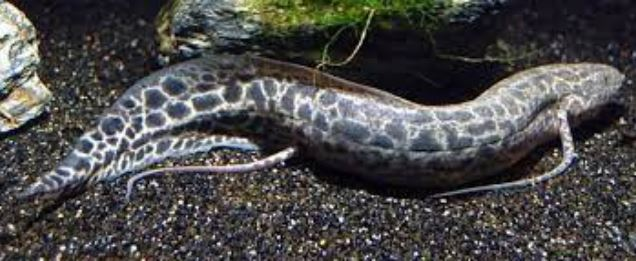
It has an elongate and sub-cylindrical body. A pointed tail that is confluent with the long dorsal and anal fins. Pectoral fins that are slender and filamentous. Toothless jaws with the dentition consisting of upper and lower tooth-plates in form of sharp cutting ridges.
Widely distributed across the country's water bodies. Known in all major lakes rivers, minor lakes, small streams and swamps associated with major rivers and lakes.
Demersal, living and feeding mainly at the bottom. In large lakes, the species occurs most abundantly in shallow inshore regions, especially in vicinity of swamps, although occasionally can be found in deep water.
Predominantly molluscivore (feeding on both gastropods and bivalves), although it also takes in insects and small/juvenile fishes.
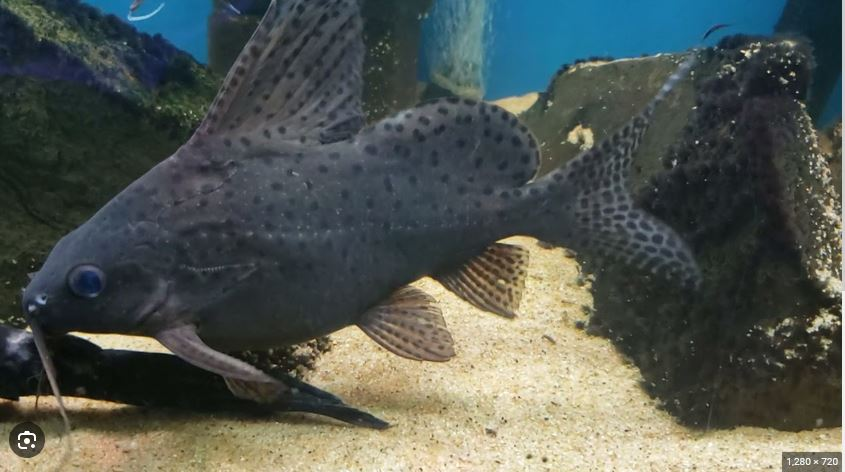
Synodontis victorie commonly called the Lake Victoria squeaker, and Nkolongo in Luganda
Synodontis fishes have pectoral spine that is articulated by means of a complicated joint so arranged that the spine can be firmly locked into its erectile position. This spine can inflict a painful wound if not handled with care. They have a greyish-silver coloration with black spots. Dorsal fin with a spine,weakly serrated on its posterior face, and 6 or 7 branched rays. Found in Lake Victoria and its affluent rivers, Lakes Nabugabo and Kyoga, and the Victoria Nile. Benthopelagic (and prefers soft bottoms although it also occurs on hard substrates), in lakes, it is common in open waters although it occurs in shallow waters too. In Lake Victoria, it is most common in waters more than 20 m.